
Pilot Techniques from a Vision Jet Professional Pilot
By Don Medine -SF50 Vision Jet Pilot Techniques
You probably won’t hear this during your initial SF50 Type Rating, or even in supplemental training, but this article contains details that might be new information to some. There are things I have learned after owning two Vision Jets, flying nearly forty Vision Jets and amassing over 1700 hours in Vision Jets.
Energy Management in the Climb: Why Airspeed Matters
One of the most common places pilots get tripped up in the climb isn’t power setting or automation selection — it’s energy management. Understanding how airspeed, altitude, and excess thrust interact will make your climbs more efficient, safer, and more predictable, especially in jets.
The vY Trap: Why Slower Isn’t Better
A key concept that often gets misunderstood is that vY decreases with altitude. That fact alone leads some pilots to believe that climbing below vY will somehow produce better climb performance.
In reality, the opposite is usually true.
Climbing below vY doesn’t give you more climb rate — it typically gives you less. When you slow down excessively, you’re throwing away kinetic energy that could otherwise be converted into altitude. Instead of efficiently trading speed for height, you’re limiting the total energy available to the airplane.
Go too slow and additional penalties start to stack up:
- Reduced cooling airflow
- Smaller engine performance margins
- Slower acceleration if you need to respond quickly
The better mental model is energy conservation. Excess thrust can be turned into airspeed or altitude. If you let airspeed decay too much, you restrict how much total energy you can carry upward.
IAS vs TAS: The High-Altitude Illusion
Another source of confusion is the relationship between indicated airspeed (IAS) and true airspeed (TAS). — At a constant TAS:
- IAS decreases with altitude because air density decreases, but we should not forget IAS is still tied to the Mach airspeed.
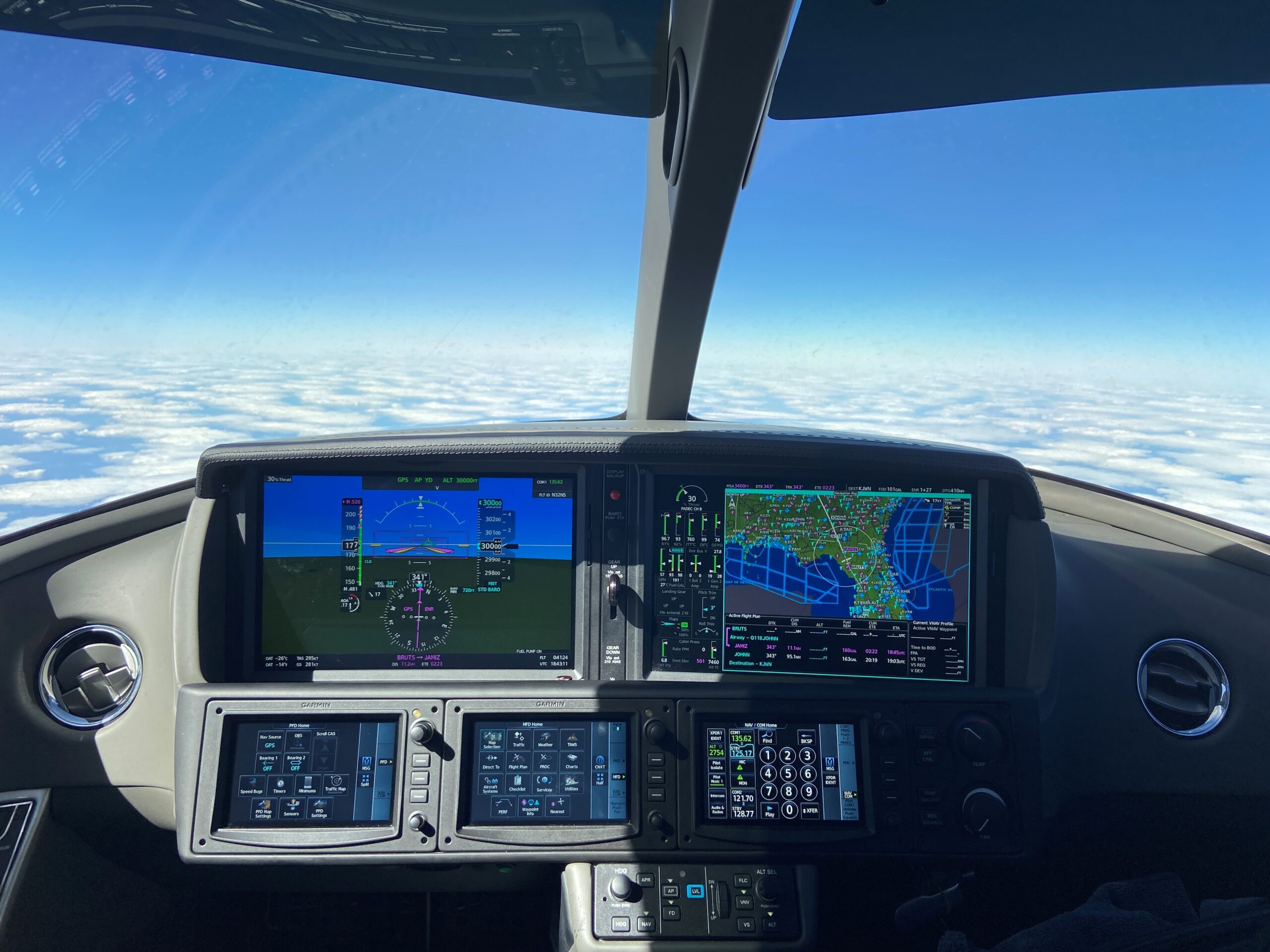
- The Vision Jet typically shows airspeed in IAS and Mach above 18,400 ft MSL.
This is why managed climbs that eventually target a fixed Mach number can show surprisingly low IAS values late in the climb. Seeing IAS in the 140-knot range near top of climb is not unusual in some jets — but that doesn’t always mean the airplane is in a healthy energy state.
Actively managing IAS in the 160–170 KIAS range (or faster if getting an acceptable climb rate) keeps the aircraft better balanced energetically than a pure “set it and forget it” managed climb that allows IAS to decay early.
My set up for most climbs is Auto Pilot and FLC mode. I do not typically arm Auto Throttle and have the Auto Throttle speed reference set to MAN (not FMS). You cannot effectively use this technique with Auto Throttle set to FMS even if Auto Throttle is not armed.
If you set the speed reference to FMS, it will simply maintains the climb speed set in VNAV/Climb, which will result in a decaying IAS throughout the entire climb. This would be the “set it and forget it” concept and less effecient for optimal climb rates, and ground speed.
Carrying a faster indicated airspeed from climb phase into cruising altitude also allows you to achieve maximum cruise speed sooner, and achieve the best ground speed possible for the given wind and ISA conditions.
A Practical Constraint: Icing and 160 KIAS
Icing adds a real-world limitation that often gets overlooked.
Below 160 KIAS in icing, you:
- Increase the risk of ice accretion
- Reduce de-ice and anti-ice effectiveness
- Lose margin for rapid pitch or power changes
Targeting 165 KIAS in icing conditions provides a sensible buffer. It preserves airflow, improves system effectiveness, and keeps the airplane responsive when conditions are already working against you.
Manual FLC: Trading Automation for Energy Control
Using FLC/IAS mode (versus VS/Vertical Speed) and actively adjusting to hold around 165 KIAS (or faster, if able) is a deliberate technique.
What it accomplishes:
- Trades some automation convenience for tighter energy management
- Prevents the airplane from getting slow and “mushy” early in the climb
- Preserves flexibility, especially in winter operations
In cold air and at lower weights, it’s common to see 175–195 KIAS while still maintaining strong climb rates. That simply reflects higher excess thrust — you can afford to carry both good speed and good vertical performance.
Summer vs Winter: What Performance Predicts
Performance trends are consistent and predictable:
- Cold, dense air → more thrust, better climb, more speed available
- Hot, high, or heavy conditions → less excess thrust
When excess thrust is limited, discipline matters more. Staying closer to vY and actively managing airspeed becomes critical to keeping the airplane efficient and well within its margins.
The Takeaway
Climb performance isn’t about chasing a single number — it’s about managing total kinetic energy. Airspeed is not wasted climb performance; it’s stored energy. Protect it, manage it intentionally, and your climbs will be smoother, safer, and far more predictable across seasons and conditions.
For more video content, check out our – YouTube channel.